Showing posts with label Lee Graham. Show all posts

Friday, November 20, 2015

Welcome the Stranger


There is a meme that has been going around on Facebook which depicts the story of the Good Samaritan. There are the two characters up the road with their backs turned, and then there is the man who was robbed and beaten and left for dead in the ditch. The person tending to him, the Samaritan is in a turban.

This story is so old and iconic that even those with only the barest exposure to this parable from Luke’s Gospel know that the big general message of this is: love your neighbor. Take care of the person in need. And, just as it says elsewhere in the Bible, those of us who identify as Christian carry an additional burden to pay very close attention to the finer details of this parable. It isn’t just any ol’ person who stopped to help the beaten man; it was a person who was very much an “other” to the lawyer whom Jesus is telling this story. Samaritans were the hated “other people.” The ones who walked away were the pure and clean—the priest and the Levite—who crossed and went to the other side. They removed themselves from this bloodied man. The robbers we only know as robbers: faceless, nameless, and wanton in their attack. And who was the beaten man? We don’t know, but the assumption is that he was a Jew, like the lawyer to whom Jesus is speaking. But he could have been anybody, another type of “other,” perhaps. The Samaritan didn’t care. He only saw the fellow human in need, and he laid down his own concerns and plans to attend to this person. Jesus posed the question, “Which of these three is the neighbor to the beaten man?” and the lawyer, probably looking down at his feet, says, “The one who showed mercy.” And Jesus says, “Go, and do likewise.” Amen!

When the Syrian refugee crisis was hitting the news as a lead story here in these far remote United States, my spouse asked me one morning, with tears in her eyes, if we would be willing to take in some refugees into our very modest home here in the swampy south land. Without hesitation, I said, “Yes.” And then I got tears in my eyes, too. How could I say “no” to one who is running away in fear from their homeland where they are either being gunned down by their government or brutalized by a bullying terrorist group? How could I look at myself and call myself a follower of the Son of God, and not accept someone into our home who is traumatized and afraid and a foreigner?

I contacted the Episcopal Migration Ministries, who told me that accepting refugees into our home would be highly unlikely given the extremely lengthy process. But they kept my information and have been keeping me abreast about how we can be of help, specifically how we could increase the extremely low number of Syrian refugees the Obama administration proposed to accept into our country from 10,000 to 100,000.

That was before the attacks in Paris last Friday and yesterday’s Congressional vote that proposes to make it damn near impossible to accept any more refugees from Syria. Everyone is afraid that someone might be a terrorist, especially if that someone doesn’t look like one of us.

This from a country that has countless politicians who cite their Christian credentials every time they run for office. How do we justify blocking the beaten and broken women, children, and elderly (who are the priorities of our refugee policy) and then call ourselves “Christian?” We had no problem back in the 1980s accepting over 200,000 refugees from Vietnam. We made it easy in Florida to accept boatloads of Cubans. Yet we close our borders to Syrians?

Where is the mercy in this picture?

As I surveyed my feelings of anger and bitter disappointment in my Congress, especially my own Democratic Congresswoman Gwen Graham, I was reminded of a paragon of Christian courage by the same last name: the Rev. Lee Graham. Same surname, but my dear friend, who passed away three years ago this week, I believe would be shaking his head about our reaction to the refugees. Fr. Graham owned up to what it means to live into the Gospel of Love when he faced extreme hatred and hostility during the civil rights struggles in Alabama. He was branded a communist during the Vietnam War because he sided with peace. And he the only Episcopal priest in this city with enough guts to put on his clerical collar and stand with the disenfranchised gay population after the devastating vote against our community in the 2008 election. He was a friend to me during those horrible days after that vote. I remember him shaking his head, and shrugging his shoulders as he told me, “Well, we gotta keep trying.”

At his funeral in 2012, Fr. Lee had apparently left directions that I was to serve as a Eucharistic Minister along with another lay minister friend, and that I was to read a passage he’d selected from First Corinthians. The last line of that passage has felt like his final words to all who seek mercy and justice in the world:

Therefore, my beloved, be steadfast, immovable, always excelling in the work of the Lord, because you know that in the Lord your labor is not in vain. (1Cor.15:58)

The Presiding Bishop of the Episcopal Church, Michael Curry, has exhorted us not to be afraid. Embracing Jesus, truly and completely, requires one to let go of fears and lay down one’s life to help another. Our Congress, and our country, has fallen far short of that goal.


Friday, July 3, 2015

A Peaceful Kingdom

"A shoot shall come out from the root of Jesse, and a branch shall grow out of his roots. The spirit of the Lord shall rest on him, the spirit of wisdom and understanding, the spirit of counsel and might, the spirit of knowledge and the fear of the Lord."(Is.11:1-2)

By now, most have heard the news that The Episcopal Church in both its House of Bishops and House of Deputies at General Convention has adopted resolutions that permit two new trial marriage rites and instructs an understanding of marriage that would include same-gender couples by eliminating the words "man and woman." These votes did not happen willy nilly. There was time for discussion. There was time to file amendments. There was most definitely time for prayer. And then there was time for voting.  And the outcome was for marriage equality in the sacraments. 

There are some who don't see it as equality. There are some who think this is a rush toward changing centuries of tradition in favor of a minority within the church. They feel as strongly in their righteousness as I feel in my convinction that the righteous act is to include all who are baptized into all the sacraments. 

There has been much ink written by people on both sides of the political spectrum of the church about this issue, and I don't need to rehash all that, or engage in arguments about the many definitions of marriage over the centuries, not to mention how marriage came to be a sacramental rite to begin with. I am happy to leave that to others to parse out. Instead, for me, I am interested in the fact that the U.S. Supreme Court presented our country with a new reality, for all of us, where I am afforded the fundemental civil right of marriage in all 50 states. This reality has been recognized by the Episcopal Church as it seeks to minister to the LGBTQ+ community which has been so hurt by the institutional church. Whether any one person or bishop agrees with this reality or not is immaterial; it is the reality. And so where do we go from here?

"The wolf shall lie down with the lamb, the leopard shall lie down with the kid, the calf and the lion and the fatling together, and a child shall lead ." (Is. 11:6)

As one who has been in the minority for a long, long time in the church, both at the intersection of being a lesbian and being a woman, I certainly understand what it feels like to be getting the short end of the stick on any particular matter. So, to the ones who are hurting at the moment, I know you are. And to the ones who hold the longer end of said stick, who continuously feel the need to remind me how to be generous to those who are hurting, thanks, but please stop lecturing me on how to exhibit Christian love. Again, I have had ample opportunity as a lesbian in the church in a much more conservative part of the country to know the pain of those who have experienced being in the minority. I am willing to listen to what pains the more conservative person about this vote. What I am not willing to do is to say that their pain is reason for me to continue being denied my place in the body of Christ. We all are part of this body, the conservative and the liberal, the wolf and the lamb. And in God's economy, everyone is a stockholder and there are no "sides"; only people. 

This is why I think the first step for those dioceses where there is still a lot of hurt and division over the Supreme Court ruling in Obergefell and the passage of resolutions A054 and A036 is for there to be a listening process across the diocese where everyone who wants to say something is given that opportunity. I believe this may serve two important purposes: one is to allow people the opportunity to give voice to their fears as well as their hopes in the march toward more faith in our risen Christ to guide us toward respecting the dignity of everyone. Some bishops may also take this opportunity to hear the full range of the voice of the Spirit as he or she discerns the best way forward for their diocese. The Holy Spirit dwells within all the faithful; listening to all the faithful of a diocese is one way to hear what the Spirit is saying to the church.

This will take time. It will take effort. And it will be worth it. If people are heard, both in their hurt and their joy, it will make whatever is the final decision of the bishop something more palatable. The only ones who won't be satisfied are the ones who insist it's their way or the highway. 

At a pre-convention forum at St. John's Episcopal Church in Tallahassee, someone asked if the resolutions were going to result in people leaving the Episcopal Church. After the rector gave his polite answer, I gave the answer inspired by the words of a crazy Christian, the late Fr. Lee Graham:

"Oh, people have been leaving the Episcopal Church for decades over all kinds of things!" I continued, "We shouldn't be focusing on our fears. We should live into the faith that we have." 

"The nursing child shall play over the hole of the asp, and the weaned child shall put its hand on the adder's den. They will not hurt or destroy on my holy mountain; for the earth shall be full with the knowledge of the Lord as the waters cover the sea." (Is. 11: 8-9)

I cannot promise that there will not be attempts to hurt and destroy. It is my hope that, as people of God, we will refrain from attacking one another and instead make a true commitment to the belief that God is working God's purpose out, and put in the time and effort to meet one another and see Christ in each other through honest discussions.  In God, as in the Episcopal Church, there are no outcasts. This is my prayer for those dioceses where there is strife and discord. 

We're all going to be OK. Really, we're all going to be OK. Trust that the shoot coming from the root of Jesse will only be made stronger if we all commit to making it work.

Monday, February 10, 2014

I Got To Hold Her Hand: Margaret C. Gage, the Anonymous Peggins

Standing by for a video shoot for the Faust Film, "The Weimar House"


The news this week has been dotted with nostalgic moments of the night when the Beatles made their first appearance on American television on the Ed Sullivan Show.  One of the songs they played was their classic early signature tune, "I Wanna Hold Your Hand." 

That would have made a good theme song for me at the end of January as my partner and I were attempting, in the face of unfriendly skies and constant flight cancellations, to get me home to New Hampshire.  All I wanted to do was hold the hand of my mother as she lay in Elliot Hospital with a ventilator in her throat.  I was lucky.  I got there in time.  I held her hand. I stroked her arm. I hummed the Episcopal hymnal to her.  I said good-bye.

My mother, known on her official documents as Margaret Bailey Clark Gage, but best known as "Hurricane Peg," passed away peacefully Friday morning at the Hyder Family Hospice House in Dover, NH.  She was 86, and more than ready to make her way home to God.  Heaven needs some organizing, and they've got the supreme force there to straighten them out.


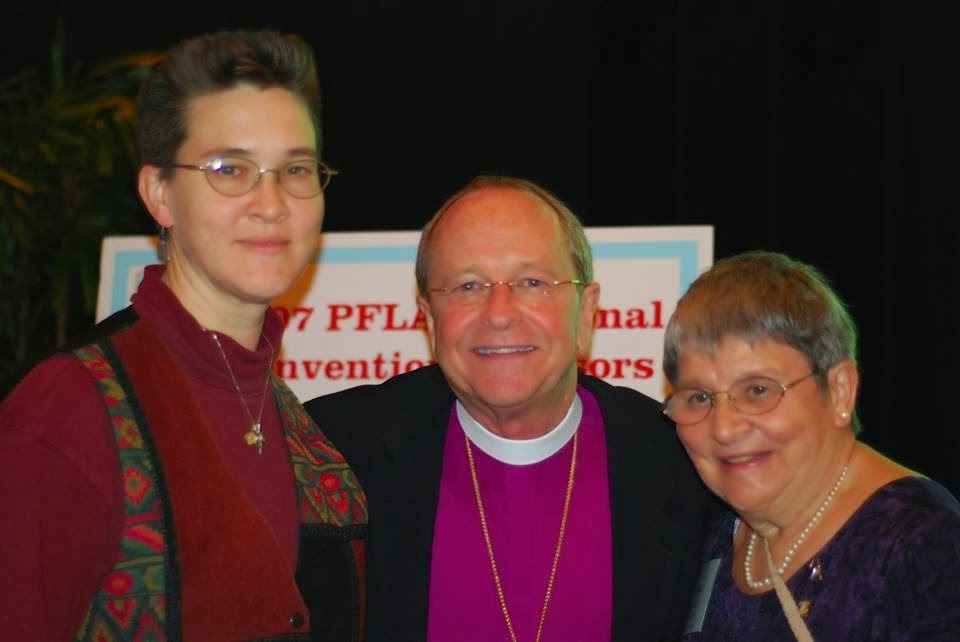
My mom was definitely a force of nature, and that's been coming through as I receive messages from all the many people who were touched by her.  Jean-Marie Navetta, the Director of Diversity and Equality Partnerships with PFLAG National, recalled the impact "Hurricane Peg" had on the Republicans on Capitol Hill:


Nothing was like going to Lobby Day with (or without) Peg. On my first-ever PFLAG lobby day, she was not able to attend. There was not a single GOP office that I visited where at least one legislative aide or congressperson themselves looked around and said, "Well you're PFLAG. But where's Peg?" As a vet of more lobby days than I can count, I can say I'd never seen anything like that before.


A Republican, and a lobbyist for equal rights for the LGBT community.  Especially the "T" community. When my mom got involved in PFLAG (Parents, Families, and Friends of Lesbians and Gays), she found many friends in the transgender community.  Every time anyone wanted to jettison including "transgender" in an effort to get "something" passed in the way of equal rights for the rest of us, my mom would bristle.  PFLAG moms and dads are not inflexible people, unless you want them to bend away from justice for their LGBT children.  Then, you better hope the branch does not come back to smack you in the face, or split your head in two! 

Mom's journey into PFLAG began when I finally got tired of fielding her questions.  She had many because, well, she had had no reason to pay attention to anything related to the LGBT community until I came out.  Luckily, I remembered seeing an article in our hometown newspaper, The Exeter News-Letter, advertising that Nora Tuthill, the wife of the doctor who delivered me, had started a PFLAG chapter.  They met in the Stratham Community Church.  I told mom about it and suggested that maybe these folks could answer her questions.

"You know Nora, mom, so these folks won't be strangers."

She went.  She saw all the most liberal women and men from our area in the room.  She listened to their stories.  And she got angry. 

What do you mean my daughter could be fired or denied housing for loving women?
What do you mean she can't adopt children because she's gay?
Are you telling me that my daughter is worth less to this society than my sons?

As I've told people, directing my mom to that meeting was the beginning of the creation I call "The PFLAG Momster."  She would call her state and federal representatives, write to them, knock on their doors, point her finger at them, and give them what-for if they didn't start righting these egregious wrongs in the name of justice and equality.  Her stated belief about politicians is that "they put their pants on one leg at a time like the rest of us," and so she was never afraid to tell them what she thought.

One time, when Sen. Bob Dole was running for President, she and my dad were visiting us in Tallahassee.  Dole was having a campaign event at the Moon, an entertainment venue only a mile from our house. 

"I want to go talk to him.  He wasn't in Washington when I was there, and I want to know where he stands on equal rights for LGBT people." 

I was not that thrilled with this idea because I really didn't want to have to go spend time around the Florida Republican Party.  So I agreed I would drop her off and pick her up.  She apparently stayed in the area close to the entry way.  When Sen. Dole came in, he saw her and looked pleased and surprised.  Mom had worked on the Ford/Dole campaign in 1976 and was an alternate to the Republican National Convention in Kansas City.  Sen. Dole and his wife Libby had spent time on our front porch, in our living room, and mom used to joke that Bob Dole was once in her bedroom... making a phone call.  So, the Kansas Republican knew very well who my mom was.

"Well, look at that!" he exclaimed, amazed to see my mother in Florida. "It's Peggy Gage! One of my long-time supporters!"

Mom wasted no time.  She smiled warmly and then went straight to her point.

"Hi Bob! I was in Washington, D.C. lobbying on behalf of my lesbian daughter.  You weren't in your office and I want to know where you stand on equal rights for gays and lesbians."

The way mom told this story, and I have no doubt about her reporting of it, it was as if all the blood was draining out of Bob Dole's face as he stammered to answer her direct question.

"Well, um, y'know, Peggy, I, um, I don't have anything personally against gays and lesbians..."

"Well, that's reassuring!" she says.

He fumbled his way toward saying something about not being against the LGBT people of the country, recognizing that this was becoming an issue.

"And I hope you'll vote in favor of the Employment Non-Discrimination Act," she said, no doubt smiling the whole time.

For her, that felt like a fun and successful evening.  For me, it felt like my mom was my shield.


When my mom and dad moved to Florida to get my dad into an assisted living facility here, my mother's biggest concern was where was she going to go to church.  She was a cradle Episcopalian, and she raised her family in the Episcopal Church.  But sadly, 2006 was a time of great bitterness and wailing and gnashing of teeth in the Episcopal churches around here because of the bishop of New Hampshire, Rt. Rev. Gene Robinson being an openly-gay man.  I had to tell mom that there was no way she could attend the Episcopal church in Tallahassee.  I drove her past St. John's and showed her how their signage didn't include the trademark Episcopal phrase about welcome, and the shield was obscured by an enormous Third Reich-looking eagle.  She was crushed.  I told her to go to one of the Lutheran churches.  She did.  It bored her. 

"OK, I'll see if I can find you an Episcopal Church."

I called Holy Comforter and asked, I think three times, for the woman to tell me if they were part of ECUSA.  "Seriously, are you an Episcopal Church affiliated with the headquarters in New York?"

The woman repeated again, "Yes."  So, I took mom by there to see the church.  She was OK with that one, but it still wasn't her cup of tea.  And she scared the rector when she met with him and started her conversation with, "I'm a Republican.  I'm from New Hampshire. Gene Robinson is my bishop and I love him!"  The poor man didn't know what had hit him.  Let's start with the fact that this is the South.  And in the South, you don't speak in such direct ways, especially if you're a lady with gray hair who uses a cane.  But my mom is a Yankee.  And Yankees don't drink sweet tea, and they don't sugar coat their opinions.

On Rosh Hashanah, I had taken my mother with me to my partner's temple.  After the almost-three hour service, we went to Lucy Ho's Chinese Restaurant to have lunch.  That's when we saw the newspaper above-the-fold headline that the rector of St. John's, in a moment of high drama in the church service, announced he was leaving and taking most of the monied people and vestry with him to start a "No Gays and No Girls" Anglican church down the street. He'd been sowing the seeds of hatred and homophobia for years in the place, but when he realized he wasn't going to be able to steal the building, he just stole about 2/3rds of the congregation, labeling the left-behinds "unorthodox."

I let out a shriek of joy.  "Mom!! Look!!! He's gone!! You can go back to that church!!"

She was so thrilled and excited.  I had told her it was the closest to what she'd know as an Episcopal Church in Tallahassee.  I got her settled in to attending services, and she found many new friends that she loved, including my eventual mentor, Mtr. Lee Shafer, and others including Fr. Lee Graham, and Fr. Harry and Lianne Douglas.  And while she was there, she continued her advocacy for LGBT rights in the Christian setting.  Given the amount of homophobia that had been infused into that church, curing them of this cancer took persistence on my mom's part.  But this wasn't anything new to her.  It just made her shake her head that she was having to go back over much of the same ground she had already tilled to make her own church in New Hampshire more gay-friendly.  But she did it while she lived here.  And I know she was very happy when I had my awakening and returned to the church to sit with her in the pew at services.


My mom was the first person I told that I had started this blog.  I was very cautious and shy about it because I really was wondering, "Why the heck am I going to start writing about being a queer Christian?  Am I mad?"  But she encouraged me with her comments.  She started out identifying herself as "MCG."  Then, for some reason, she found the comment section frustrating and insisted that she was going to post using the anonymous setting. 

"OK, but please sign your name," was my compromise.

And so, she'd post under "Anonymous," and then sign with her childhood nickname, Peggins.  This is how I came to identify her as "The Anonymous Peggins."  I gave her a gift one year of my blog as a book.  She loved it.  She told me that she kept it on her bedside table and read it over and over for a couple of weeks.  She encouraged me to take what I've posted here and turn it into a book of spiritual writings especially for those who have felt betrayed and abandoned by the church because of their sexual orientation.  I have known that pain, and I have come to realize that the many misdeeds done in the name of Christ over the decades do not negate the true message of Christ: that I am loved, I always have been loved, and I always will be loved.

I found it quite fitting that the day my mother died was Friday, February 7th, the day the Episcopal Church commemorates Cornelius the Centurion, one of the many early Gentiles that the original apostles encounter and discover--much to their surprise--that even these supposedly "unclean" people are destined to be baptized with the Holy Spirit.  The reading from the Book of Acts is of the time when Peter, starving, dreams he sees a sheet come down with all kinds of "unclean" livestock.  He's instructed to kill and eat.  Peter protests, noting that these are not clean.  And God rebukes him, reminding him that "What God has made clean, you must not call 'profane.'"  He's then led to find Cornelius and baptize him.  That's when the eyes of Peter's heart open and he realizes that there is no distinction to be made between Jew and Gentile.  And we all say, "Thanks be to God," that he figured that one out!

These are the stories that also speak to us queer Christians about how deep, broad, wide, and unceasing God's love is for all of us; hence there is no real justification to leave us standing at the gate.  Mom enjoyed how I would articulate these messages, and she'd occasionally send them off to her clergy in New Hampshire with a "Look what my daughter wrote!" I simply articulated the message of Christ, which is the message of PFLAG, which is the message of my mom: Love.  Period.

May she rest in peace and rise in glory and may light perpetual shine upon her.

 
Margaret C. Gage, June 19, 1927-February 7, 2014
 
A Celebration of Life is scheduled for Saturday, February 15, 2014 at Christ Church, Exeter, NH, at 11am...followed by a luncheon reception in Harris House (the church parish hall)  Visiting hours will be the afternoon before at Brewitt Funeral Home.  Donations in the memory of Margaret "Peg" Gage may be made to PFLAG National (www.pflag.org) or NHSPCA (nhspca.org).




Sunday, November 17, 2013

Lessons Being Learned

It is the 26th Sunday after Pentecost, and that brings us what I have come to call, "The Lee Graham Collect":

Blessed Lord, who caused all holy Scriptures to be written for
our learning: Grant us so to hear them, read, mark, learn,
and inwardly digest them, that we may embrace and ever
hold fast the blessed hope of everlasting life, which you have
given us in our Savior Jesus Christ; who lives and reigns with
you and the Holy Spirit, one God, for ever and ever. Amen.

Father Lee would use this collect before his homilies on Fridays at our 12:10 Eucharist.  It is so fitting that, as we approach his Yahrzeit, that this is what will be said in Episcopal Churches across the country.  And the holy Scripture lessons for this particular Sunday give rise for some reading, marking, learning and inwardly digesting as Isaiah talks of the promises of a new creation, and then Paul's Second letter to the Thessolonians has warnings about idleness, and finally we reach Luke's Gospel message in which Jesus tells us that we will encounter false prophets, and strife and hardship, but he will give the words we need in all situations.  

As I reflect upon those scriptures, that particular collect, and the man who brought that collect alive for me, I hear hints of some of the Scriptures that were used at Fr. Lee's funeral last year.   He, too, choose a passage from Isaiah that reminds us that "the Spirit of The Lord God is upon me" to bring Good News, free the oppressed, bind up the broken-hearted.  The other lesson was from 1 Corinthians which, again, sounds so similar to what is in our readings.  The last line of the passage, which the selection was about the mortal body becoming immortal, says, "Therefore, my beloved, be steadfast, immoveable, always excelling in the work of The Lord because you know that in The Lord your labor is not in vain."   I hear in these passages, as well as the ones assigned for the 26th Sunday After Pentecost in Year C, a two-fold encouragement to allow our selves to become the vessels of change in the world, doing the mission work of God to love in an active way all the people, plants, and animals around us who need loving... and to be prepared for this to be an uphill mission as we will meet all kinds of resistance to Love.  

Now, according to the Borg on Star Trek: Resistance is futile.  And that applies to the case of Love, too.  Much as any society or culture has attempted to move away from God, and declare itself independent of a force of Love greater than our understanding, it really hasn't worked.  I think if it had worked, then there wouldn't be the zeal for knowing God that I saw exhibited in the film "Jerusalem."  The 45-minute documentary isn't on God, per se, but it is on the historic city that sits at the center of a crossroads of Europe, Africa, and Asia, with three Abrahamic communities, Jewish, Muslim and Christian, each finding something dear and sacred about their city.  If Love were driven out, then I don't think we'd still have people laboring for the rights of the oppressed and the needy, for the civil rights and liberties of LGBT people and immigrants, racial minorities and women.  

Some may point to the recent typhoon in the Phillipines and say, "Well, where is God in that horror?  How could a 'loving' God allow that to happen?"  I saw a meme on Facebook that I think answered that question quite well.  A man is sitting on a log in a forest with Jesus.  Most of the picture is dimly colored, except Christ, who is brighter in appearance than the man.  The man is posing that kind of question about "bad things happening to good people" to Jesus in that accusatory, "How can you let these things happen?"  Jesus responds: "Funny, I was going to ask you that same question."   A typhoon of such magnitude is a weather phenomenon; hence something from nature and beyond us.  We can not control or redirect the winds.  HOWEVER, the strength and intensity of these storms do have a tie-in to our own human-made destruction with the release of more carbon gases and other pollutants that are contributing to global warming.   At this point, there are almost no scientists willing to argue that climate change isn't a real concern for us all.  The warming of the planet is likely contributing to the ferocity of these storms.  But there is still push back from those who don't want to have to change the way we've been treating the Earth because it might cost more, or, more accurately, it would cut into their profit margins.  What is it that Jesus said in the Gospel lesson?

"When you hear of wars and insurrections, do not be terrified; for these things must take place first, but the end will not follow immediately." Then he said to them, "Nation will rise against nation, and kingdom against kingdom; there will be great earthquakes, and in various places famines and plagues; and there will be dreadful portents and great signs from heaven. 

I interpret that statement as "Bad things will happen.  People will scorn and resist other people. But this isn't proof of no God and no Love.  It's how things are in the world you live in."   The promise of Christ is that he will give what is needed to endure whatever comes, and He knows how much the current situtation--be it the ruins left from a typhoon, the death of a loved one, the loss of a job--hurts like hell.  Christ is God as the human who understands the hole of grief in our hearts.  In turn, we, as the new incarnation of Christ in our current times, can offer that same sense of sitting with the pain of others, and then doing those things that we can do to help.  When it comes to something as seemingly beyond our control as global warming, we can start with how we handle our own waste and become more conscious of our personal habits of what we throw away, how often we drive when we could walk.  In the case of a catastrophe such as the Philippines, we can contribute to a reputable agency such as the Episcopal Relief and Development fund, so that the majority of our money gets to the people in need.  These are the ways I see that we can be Love in the world.

As St. Paul says in his second letter to the Thessolonians, "Brothers and sisters, do not be weary in doing what is right."  This is what is meant by the Spirit of The Lord being upon us, and remaining steadfast, immovable and always excelling in the works of The Lord. This is what it means to read, mark, learn and inwardly digest the Scripture and let it power our actions and responses to the world around us.


Tuesday, November 5, 2013

Odd Balls Are Cool

As a bit of a carry-over from All Saints' Day, I was talking with someone on the steps of St. John's the other night about one of my favorites of the recently departed, Fr. Lee Graham.  We were both remembering separate instances in which Father Lee reflected upon the sad reality of being an Episcopalian.

We aren't going to be popular.  We aren't going to out pace everyone else's denomination in church membership.  We are, for a lack of a better way of putting it, odd balls.  And that's OK.

In fact, it's more than OK.  It is what makes us followers of Christ.  Christ never said that following a path which demands letting go of selfish desires in favor of loving those around you, including people you'd really rather not be with ever, was going to be easy.  Love may be patient and kind, but it isn't easy and requires some sacrifice of our selves.  Now, honestly, who would want to sign up for that?  Answer: the odd balls.

Certainly, Episcopalians, such as the late Fr. Lee Graham, fall into that category.   Fr. Lee and his wife, Betty, always seemed to be on the look out for the other odd balls and misfits, and were always including them and opening the doors to the church wider.  It would sometimes result in people leaving, which Fr. Lee didn't seem to fret over.  

"I don't remember a time when someone wasn't leaving the Episcopal Church for one reason or another!" he laughed during an interview in February, 2012.

And then he and I shared our common belief: that what makes the Episcopal Church strong is the ability to disagree with each other and still continue to come to the Lord's table and be shoulder to shoulder at the rail.  It's when people take their marbles... or attempt to take church property... and storm off that we cease to be Episcopalian or any kind of Anglican for that matter.  That's certainly something many parishes in this area have had to deal with in the past decade.  And the hurt from those splits was enormous.  Still, those who stayed have grown stronger, and have attracted new odd balls or old odd balls that had rolled away to come back in.  

But the secret to the success of Christ in the world today is for those who have come back in to then go back out.  We aren't supposed to be about staying put inside the safety of our churches; we are to go out and love and serve "The Lord" in our homes and our work places.  Does this mean proselytizing on street corners or at the water cooler?  No.  That isn't the Episcopal way.  Ours is more like what Canon Frank Logue of the Diocese of Georgia once depicted in a video: we're ninjas.  We go about living out our faith in the actions of how we treat others we encounter.  We listen to people and care about what's happening in their lives.  And we don't use them as a means to an end that benefits or gratifies some desire of our own.  Living this way requires one to be a bit of an odd ball because there is no reward for it beyond the satisfaction of knowing that Love is a powerful force in the world, and its ready for all of us to tap into it.

Being an Episcopalian doesn't make you a "favorite" or earn you a bunch of "Likes" on Facebook.  To be an Episcopalian means to spread the favor of Love to others, with no expectations or attachments for your self.  
   

Saturday, August 3, 2013

I Still Remember

August 2nd would have been the Rev. Canon Lee Graham's 93rd birthday.  In a fitting tribute, the rector of St. John's remembered Fr. Lee at the Friday noon day service, the service which the late Fr. Lee used to celebrate every week.  We prayed for the repose of his soul, and we lifted up his widow, Betty, and his whole family.  I know they miss him.  We all do.

And some of us seem to get periodic reminders of how his presence in our lives moved us out of our comfort zones, and our natural tendancies to want to sleep walk through this life.   Such has been the case with me.  I cannot encounter some passages of Scripture, or certain psalms, or think of the phrase, "Read, mark, learn and inwardly digest it" without hearing the voice of Lee Graham.  I cannot contemplate the actions of the Dream Defenders, and their ongoing peaceful protest of our racially-divisive laws without thinking about how Fr. Lee would likely have commented on this, and drawn upon Scripture to tell us in our comfortable place at St. John's why we should be stirred up... and out of our comfort zone... to care about this issue.

He was on my mind this summer as I read through Andrew Harvey's critique and position on who Jesus was, and how the Church, through its councils and concepts of Christ, have missed the mark... and in the process... also crushed the feminine presence inherent in God.  Each time something Harvey argued made me squirm, I had this sense of a miniture Lee Graham sitting on my shoulder, reminding me, "You have to question your faith!"   That's what he wanted people to do as he argued against the phrase, "You are dust and to dust you shall return."   He didn't want people to go as sheep to present themselves to a priest for the imposition of ashes without first asking themselves the question, "Am I dust?  Am I as worthless as dust?"  For Fr. Lee, the answer was, "No!  I am a child of God!" and he believed the Church put this practice of ashes on the forehead at Ash Wednesday as a means of guilt-tripping people.  If Andrew Harvey could have met Lee Graham, I think they would have hit it off!

I definitely felt his presence at the Eucharist this noon-day service when the phrase that popped out at me was how Christ, "stretched out his arms upon the cross in obedience to (God's) will..."  I thought about Fr. Lee, and the sacrifices he made in Alabama, and even in Tallahassee, in pursuit of racial justice, peace, and really making us live up to the promise to treat everyone with respect and dignity.  His stories of showdowns with vestries and others over the integration of the church, sometimes prevailing and sometimes finding himself the minority voice in a room filled with bigots, used to give me some comfort.  Like Christ, all of us who have ever stood up against the machine of "the majority" when it was necessary to do so in an effort to prevent the machine from rolling over a minority, know what it's like to be the one standing in front of that steam roller.  In this way, we, too, are stretching out our arms on our own metaphorical crosses, trusting in God, even if we are about to get nailed.  When I heard Fr. Lee talk, I heard in his stories similarities to some of my own.  I guess misery loves company, in this case.  

At his funeral, Fr. Lee requested that I read a passage from 1Corinthians: 

Listen, I will tell you a mystery! We will not all die, but we will all be changed, in a moment, in the twinkling of an eye, at the last trumpet. For the trumpet will sound, and the dead will be raised imperishable, and we will be changed. For this perishable body must put on imperishability, and this mortal body must put on immortality. When this perishable body puts on imperishability, and this mortal body puts on immortality, then the saying that is written will be fulfilled:
‘Death has been swallowed up in victory.’ 
 ‘Where, O death, is your victory?
   Where, O death, is your sting?’ 
The sting of death is sin, and the power of sin is the law. But thanks be to God, who gives us the victory through our Lord Jesus Christ. 
Therefore, my beloved, be steadfast, immovable, always excelling in the work of the Lord, because you know that in the Lord your labour is not in vain. 

I have read, marked, learned and inwardly digested this passage, especially that last line. In The Lord, my labor, my pursuit of justice and desire to see Love spread beginning with what flows from my own heart, will not be in vain.  Thanks be to God, and to Fr. Lee Graham.  


Friday, November 30, 2012

St. Andrew

"Almighty God, who gave such grace to your apostle Andrew that he readily obeyed the call of your Son Jesus Christ, and brought his brother with him: Give unto us, who are called by your Word, grace to follow him without delay, and to bring those near to us into his gracious presence; who lives and reigns with you and the Holy Spirit, one God, now and for ever."--Collect for St. Andrew, apostle and patron saint of Scotland

It happened again at the noon day service at St. John's. Words from the service caught me by surprise, and left me thinking about them hours later. The above collect was just one example. "Give unto us, who are called by your Word, grace to follow him without delay, and to bring those near to us into his gracious presence."

Our homilist emphasized the idea of "call" and what God may be "calling" us to do. She noted that Andrew, like Peter and the others, immediately dropped their fishing nets to follow after Christ. Maybe we are all called to drop something, whatever might be the routine or what we think is the expected role we are to fill, and follow a path to Christ?

I also heard the part of our Post Communion Prayer, again, that I have talked about before on this blog: "Send us now into the world in peace, and grant us strength and courage to love and serve you." I thought back on my late good friend, Fr. Lee, and what he did in his lifetime. I thought about what it means to have the strength and courage to love God... and serve as a witness to that Love of God which is enormous and unlike any other. That love that holds you up as you stare injustice, inequality, and stubborn resistance to change in the face.

Is this my call?

Saturday, November 24, 2012

In the Lord Your Labor Is Not in Vain

Yesterday, we said good-bye and farewell to Father Lee Graham, Jr.  I was honored that my friend had asked that I be one of the lectors at his funeral.  I hadn't dared put in a request to participate, figuring that with all the people who have ever felt close to him, there would be a line a half-mile long of folks who would want to be chalice bearers, lectors, ushers, pall bearers, altar guild members to serve one last time along this servant of God.  So, when I learned that he had put it into his notes on his funeral plan to have me read, I cried.  Again.

And then I read the passage he had selected for me to read, 1 Corinthians 15: 51-58.  And I cried.  Yet again.  All the Scriptural selections he made were a beautiful combination that sounded so much like him preaching one last homily for all of us.  And I definitely felt the words he had chosen for me to communicate to the very large congregation were picked with a purpose.  And so, in honor of Fr. Lee, I thought I'd take us through this particular set of verses, as I understand them in light of my theology as of November 24, 2012:

Listen, I will tell you a mystery! We will not all die, but we will all be changed, in a moment, in the twinkling of an eye, at the last trumpet. For the trumpet will sound, and the dead will be raised imperishable, and we will be changed.

This is some mystery, isn't it?  A mystery which speaks to many kinds of life and death.  But I'll just stick with the death of the physical body.  It may seem the person is "dead", but the inhabitant of that body, that inner spirit that once animated the body our senses know as "the person", is not "dead" but it has changed and assumed a new body...one unseen and unknow to those of us in this world.  That person has "changed".  And those of us left behind to mourn the physical death have also changed because we mourn the absense and presensce of that person we perceived through their perishable body.  This is a mystery of energy, and understanding the difference between the physical and the energetic (spiritual) body.  Let's continue...

For this perishable body must put on imperishability, and this mortal body must put on immortality.When this perishable body puts on imperishability, and this mortal body puts on immortality, then the saying that is written will be fulfilled:
‘Death has been swallowed up in victory.’


For those who do believe that life continues beyond this life we know on planet earth, and that there are dimensions of life that are the places of the saints (or the ancestors, in some customs), then this riddle-like statement put forth by St. Paul makes sense.  Once the spiritual body has put on a new existence that isn't the perishable body where it lived and moved and had its being with us, then it rejoices in the experience of new life, life that is bigger and brighter than where it has been before.  Don't let this be confused with "eternal or everlasting life."  That, too, exists in a bigger and brighter form in that realm that is beyond us.  But, according to my theology of November 24, 2012, we are capable of experiencing eternal and everlasting life now if we will yield to God and allow God, not our own petty egos, to be the center of our existence.

‘Where, O death, is your victory?
Where, O death, is your sting?’
The sting of death is sin, and the power of sin is the law. But thanks be to God, who gives us the victory through our Lord Jesus Christ.


Because, for those who do believe in life beyond this realm, death of a physical body does not have the final victory over our spiritual selves.  Because, for those who do believe that there is something more, we have seen an example of this victory in the story of Jesus, who claims new life in the resurrection.

Therefore, my beloved, be steadfast, immovable, always excelling in the work of the Lord, because you know that in the Lord your labour is not in vain.

This, I believe, was the statement that Fr. Lee intended for me, and others, to hear, read, mark, learn and inwardly digest.  A man who knew his Scriptural teachings backwards, forwards and sideways, and had them in his heart as he pursued the most unpopular and difficult paths for justice in his time and until his death.  This was the part of the passage that made me bawl each time I practiced my reading.  The thought that all that we do in this life to make things better for everyone does not end when our physical body ceases to exist, and that as long as we are in this life, we are to be striving to look out for those who have not experienced the liberating love of Love.  That is the task before each of us who seeks to do justice, love mercy and walk humbly with God. 

Thanks be to God for having given me a chance to learn from a teacher like Father Lee Graham, Jr.  He has left an indelible mark on my spirit.

Monday, November 19, 2012

May Light Perpetual Shine Upon Him: Rev. Lee Graham, Jr.

Blessed Lord, who caused all holy Scriptures to be written for
our learning: Grant us so to hear them, read, mark, learn,
and inwardly digest them, that we may embrace and ever
hold fast the blessed hope of everlasting life, which you have
given us in our Savior Jesus Christ; who lives and reigns with
you and the Holy Spirit, one God, for ever and ever. Amen.

This "Collect of the Day" assigned for this Sunday is the one I refer to as the "Lee Graham Collect" because this is the prayer Father Lee would use on Fridays before his homilies. And quite often, what Fr. Lee would share with our congregation of about a half dozen people were the ideas he had gleaned and considered carefully as he heard, read, marked, learned and inwardly digested the holy Scriptures over a long life of serving in the church.  Somehow, then, it is fitting that on this Sunday, Fr. Lee Graham, Jr. went on to be with the saints who have entered into joy.  He was 92.

I have written about Father Lee so often on this blog through the course of the years as I have gotten to know him and serve with him on Fridays at St. John's.   He has lived an amazing life of overcoming his own prejudice as a young white Southern male priest who was one of the recipients of Martin Luther King, Jr.'s letter from the Birmingham jail.  The civil rights struggles in Alabama during the early 1960s  tested Father Lee and he took up his cross to fight for equal rights for black citizens.  Fr. Lee used to tell one story of the vestry meeting where he was instructed to keep quiet as the group laid out plans to get dogs to patrol the parking lot during an Easter service to prevent black families from coming to church. Fr. Lee listened for awhile, and then asked if they wanted to know what their rector thought of this plan.

"If you do this," he said, "I will not celebrate an Easter service."

"Are you quitting?" they asked.

"I didn't say that," he replied.  "I said if you have dogs and patrols in the parking lot, I will not celebrate Easter."   That ended the vestry's plan, but not the racial tensions in Alabama.

Fr. Lee and his wife, Betty, then moved to Tallahassee where he became the rector of St. John's Episcopal Church for almost twenty years.  Racism was still an issue in Florida's capital city, but nothing nearing the brutal nature of Alabama.   Early in his tenure, an usher who was a state Supreme Court justice turned away a black family from the church.  Fr. Lee, recognizing that the man held a position of power in the state and was a muckity muck at St. John's, nonetheless quietly took care of the matter but never allowing the man to usher again.  The Grahams were about bringing people, all people, into the church; not keeping them out.  He survived the angst about women in the priesthood, girls as acolytes, a new prayer book and hymnal.  He provided space for pregnant teenage girls in the county to attend an afterschool session, so they could complete their requirements for graduation (since the county wouldn't let them attend with the other children).  His food and clothing ministry eventually became ECHO, a program that continues to this day in Tallahassee.  The Grahams were always on the lookout for who was not experiencing the liberation of Love.

No place was that more evident than in the way Lee and Betty Graham treated me and others in the gay community.  During the horrible aftermath of Florida's vote in 2008 to ban marriage equality in the state constitution, Fr. Lee was the only priest at St. John's who recognized the pain in my face, and offered words of love and encouragement to me at a time when I felt the world and even the church was against me.  The Friday before that election he had used his homily as a time to preach about the evils of exclusion, and specifically called out the church and society for their treatment of the LGBT community. I cried.  It was the first time anyone at St. John's had even dared to say anything in response to the lies that had been, and were being, told about us in the public square (mind you this was the church that under another rector had embraced homophobia as kinfolk). He openly praised Bishop Gene Robinson for his frank discussions of human sexuality, and didn't shy away from stating over and over that equal rights for the LGBT community was the new civil rights struggle for the church and for society... and both had better get on with establishing justice in the gate.  And when I told him about a rally that would be happening at the state Capitol building for LGBT equal rights, he was there, in his priestly blacks amidst a sea of 20-and-30 year olds.

The Grahams also spent about eight years in Memphis where Betty Graham got the city police department up to speed on dealing with crime suspects who had mental illness issues.  The police officers had no idea what to do with suspects who suffered from psychological problems and would usually use brute force or stun gun them.  Betty and some others involved with the National Alliance on Mental Illness   met with the police chief, and offered to train the officers.  Several of the cops signed up for her workshop, and Memphis became the model for the national movement to train officers in how to respond to the mentally ill.

I loved serving with Lee at the Friday noon day service.  He kept things simple, but didn't lose any of the joy embedded in the liturgy.  His homilies were teaching moments, and on occasion he would employ a rabbinic style of asking questions to get us engaged in our own learning, reading, marking and inwardly digesting of the message of Love.  On one Friday, I remember walking into St. John's with him as we were going to vest and prepare for noon day.  The feast day was that for the Ugandan martyrs.  I shared with him my concerns about what is currently happening in Uganda with the LGBT community  Fr. Lee decided that what he was going to say needed to reflect the reality of the current situation, and so he turned to me and asked me to share with everyone about the "kill the gays" bill, and that, rather than the text from Holy Women/Holy Men, became the basis for his homily. 

Father Lee was a tremendous man, and I thank God I had the opportunity to get to know him.  Prayers for his wife, Betty, and his children and grandchildren.