Showing posts with label #VTS. Show all posts

Sunday, September 24, 2023

Knowledge is Power: A Sermon for the Feast Day of St. Anna Alexander


We’ve all heard the phrase “Knowledge is power.”

Teachers know this well.

People who enter the teaching profession don’t do it for the great pay and certainly these days they don’t do it because they think they’re going to get a gold star or a medal of some kind.

For many… the motivation to teach comes from their own insatiable appetite to learn. And then they want to pass along what they’ve learned to others.

The reward for their work comes when they see in the face of a child that spark… when a connection gets made… and there’s the big “a-ha!”  

And there is so much joy in watching a student fall in love with learning.

One of my friends who teaches at Florida State says that she realized recently that her years and years of study… and then working in the world of academe gave her the advantage of knowing how to persist in the face of bureaucratic red tape.

Universities are great big bureaucracies.

Knowing how to negotiate through them is a learned skill. And it’s these skills that one carries into every day life.

Again…”knowledge is power.”

I think that’s one of the reasons why it’s so disturbing to see political leaders actively working against teachers and their abilities to pass along knowledge.

Teachers have a passion for wanting to encourage students to understand the world and be able to think through problems and find solutions.

They want to encourage the next generation to recognize the mistakes of the past and lead us to a better future.

Not only is knowledge powerful… it leads to independence.

Teachers know this.

Anna Alexander knew this.

You have in your bulletin insert this morning a very brief history of Deaconess Anna Alexander’s life. But there’s much more to be said about this remarkable woman who our Episcopal Church recognizes as among the saints of our tradition.

Anna was the youngest of eleven children. Her parents… Aleck and Daphne Alexander… had been slaves in the mid-1800s. Aleck was a waiter on the Butler Plantation outside of Brunswick.

That’s where he encountered the retired English actress Fanny Kemble, the wife of the plantation owner Pierce Butler.

Aleck was a teenager…and he begged Fanny to teach him to read and write.

Unlike her husband… and the rest of rural Georgia society at the time… Fanny was a staunch abolitionist.

Georgia law prohibited teaching the African slaves…but Fanny did it anyway. And Aleck proved to be an exceptional student.

When Aleck and Daphne married… they moved to Pennick to start their family.

They both had a keen appreciation for how important education had been in their lives.

And they knew this would be the bedrock for their children as well as they prepared them for the world.

The family were all Episcopalians and so their two major textbooks became the Bible and the Book of Common Prayer.

Anna took to education like a fish to water.

She left Georgia and graduated from St. Paul’s College in Lawrenceville, Virginia…a school founded by the Reverend James Soloman Russell…an African-American Episcopal priest who had been one of the first graduates of Bishop Payne Divinity School… a school started to train blacks for the Episcopal priesthood.

My own alma mater...Virginia Theological Seminary…had refused to train black men for ministry…hence the need for Bishop Payne Divinity School.

When Anna went back to Georgia…she joined her sisters Mary and Dora in teaching at St. Cyprian’s School in Darien. Anna was living in Brunswick.

Every day…she would make the trip to Darien by foot and by row boat to teach children.

It was during a service at St. Athanasius Episcopal Church in Brunswick… that Anna felt a call to start a school and later a church in her hometown of Pennick. With the help of one of her brothers…they built a one-room schoolhouse and later added a loft above the classroom where she lived.

In 1901…Anna had her first six students. The following year… they opened their church…The Church of the Good Shepherd.

About five years later… the Bishop of Georgia…C.K. Nelson… went against the Southern cultural norms of the time and he ordained Anna Alexander as the first African American deaconess in the Episcopal Church.

This was the formal recognition of her calling to be an educator. Deaconesses in the Episcopal Church were women operating in various service professions…including teachers. Anna’s teaching…like that which her parents had instilled in their children… was very much tied to the Book of Common Prayer and the Bible.

Unfortunately…her ordination in 1907 came at the same time that there was a split in the diocese of Georgia. The state’s population had grown enough that The Episcopal Church created a second diocese…the diocese of Atlanta…and sent Bishop Nelson to the west.

Georia elected a new bishop named Frederick Reese…a man who didn’t know Anna Alexander.

Bishop Reese and the diocese of Georgia segregated their convention… excluding the eight black congregations from participating in the larger life of the Episcopal Church. The separate Council of Colored Churchmen went largely unnoticed by their white counterparts.

This disparity continued until 19-47…the year Anna Alexander died.

But knowledge is power.  And Anna Alexander knew how to work around the church to continue to seek funding and support for her school and Good Shepherd through the program that is now the Episcopal Church Women or E-C-W.

She kept teaching and encouraging the children of Pennick.

She started taking them on trips to visit some of the historically black colleges including Fort Valley State…Voorhees University in South Carolina and her alma mater St. Paul’s in Virginia.

In our Gospel… Jesus encourages those who are getting held down under the thumb of an oppressive Roman Empire to turn to him…and ‘take his yoke’ upon them.

This is a Jewish phrase for “be my student” or “let me be your tutor.”

What Anna Alexander provided to her community was fifty plus years of breaking down barriers and opening the world to children in very rural Georgia in ways that might never have happened for them otherwise.

Thanks be to God for her and for all those who today persist with determination to teach and excite the minds of the next generation.

In the name of God…F/S/HS.


Sunday, December 19, 2021

Mary the Prophet: A Sermon for the Fourth Sunday of Advent at St. Barnabas


 Back to St. Barnabas, I feel as though I was picking up where I left off when I was last with them two weeks ago. When I was in seminary, I didn't dream that in my six months of my diaconate that I would be called on to preach each Sunday of Advent. But there's been nothing "usual" about my journey from day one, so why start now? And so on the Sunday when eight of my classmates presumably were celebrating their first time as presiders at the Eucharist, I was preaching my fourth sermon in as many weeks on a theme inspired by a statue on the VTS campus. 
 

O Day Spring, splendor of eternal light, Sun of Righteousness; come and enlighten the darkness of our minds. O Key of David, come and open wide the secret places of our hearts that we may receive you who came among us at Bethlehem, and who comes among us daily in the unfolding of our lives, and will come again in glory in the age to come. Amen.--"Advent" Praying Our Days by Bishop Frank T. Griswold.


Rejoice! Rejoice! Emmanuel shall come to thee, O Israel!

The tune is written in a minor key, but this hymn and the Gospel lesson from today are full of hope and exuberant joy…full of promise that God has never forgotten the people and is coming to dwell in us…around us…and beside us always. Even more amazing: God is coming to do some radical reordering of things. Any notions of “well this is the way that it has always been” is about to go out the window. With apologies to those among us who like things neat and tidy…God is about to shake things up like a snow globe. And—because we are in the Year of Luke’s Gospel—the women are going to be leading the way.

We get that in today’s encounter between Mary and her Aunt Elizabeth.

This story is often called “The visitation of Mary to Elizabeth.” But that doesn’t quite cut it for me.

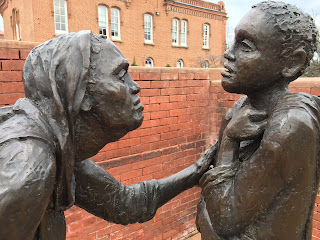
On my seminary’s campus, there is a statue by the artist Peggy Adams that is near the VTS chapel. Adams titled her work, “Mary as Prophet.” It shows two women…one very old and one much younger. The older one has her hand on the shoulder of the young woman and is leaning into her, while the younger one raises her eyes to the sky and seems to be exclaiming something deep within her. I think that’s a pretty accurate description of what is happening in this scene.

Our Gospel lesson picks up right after the moment we just sang about where Gabriel comes to Mary and tells her she is going to be the God-bearer. She’s blown away by this news…and really who wouldn’t be? Think about it: you’re about thirteen or fourteen years old. An angel shows up out of nowhere and tells you that you’re pregnant…in a society where that’s not supposed to happen until you’re married.

Oh, and this is not just any child: this is the Son of the Most High!  You’re given instructions about his name and he’s going to sit on the throne of David...

I mean…this is wild!! And if it gives you goosebumps…well…yes.

And young Mary…brave Mary…wipes the sweat from her brow and gives her consent to this news. Now, she could have gone into hiding…and who could blame her under the circumstances.

But the angel told her that her cousin Elizabeth was also pregnant and….

What?!?!?! Elizabeth?? Old lady Elizabeth? Barren Elizabeth whose husband the priest has been struck dumb??

This story is getting crazier!

So, Mary heads out to the Judean hill country.

Was she going because she was afraid?

Was all this news too much and she must see for herself?

Or was she…as Peggy Adams’ statue suggests…a prophet? Not just the womanly womb carrying the Christ child…but is she also a prophetic witness heralding the incredible goodness and greatness of God?

I think that gets confirmed in the exchange with Elizabeth. Even before Mary could say much of anything beyond…”Cousin!”…Elizabeth felt her baby John leaping and kicking and stirring for joy…as the Holy Spirit filled her heart.

She bursts out…”Blessed are you among women and blessed is the fruit of your womb!!”

There is amazement…astonishment…and tearful acknowledgment of how incredible it is that her young niece is coming to her…the older woman…and her own baby is dancing a jig…as they both realize that Mary is the mother of the Son of the Most High.

My New Testament professor describes Luke as the Shakespeare of the Bible because of his beautiful and poetic language.

But I sometimes like to refer to him as the Rogers and Hammerstein…or even the Verdi of the Bible because of moments such as this one…where these two pregnant women…overcome with the Holy Spirit…break into a recitative followed by the aria of the Magnifcat:

My soul magnifies the Lord

And my spirit rejoices in God my Savior.

My soul **magnifies** the Lord!

Elizabeth’s response confirms the Angel Gabriel’s message…and Mary hearing that senses deeply that she…a teenage mother…is getting swept up into a larger than life mission. Her song goes on…

He has scattered the proud in the thoughts of their hearts

He has brought down the powerful from their thrones

And lifted up the lowly;

He has filled the hungry with good things,

And sent the rich away empty.

As I said at the start of this sermon…God is shaking things up. This mission is not one where the C-E-Os or the well-heeled or the rich and famous get to take center stage. No, no! God is working God’s purpose out by bringing the Light…that’s capital “L” light…to the nations from the least likely and the most easily overlooked and ignored. Mary…acting as a prophet to the marginalized, the disinherited.. is announcing:

Rejoice! Rejoice! Israel…Emmanuel…God with us…the Almighty has remembered the covenant. We aren’t forgotten! We aren’t forsaken! Rejoice!

Rejoice…even in this time where we live as subjects to an empire.

Rejoice…even in this time when we get bullied by Roman soldiers and tax collectors.

Rejoice…Sing…Dance…you, young girl and old woman! God is with us!

Elizabeth…the elderly mother of John…joins with Mary…the youthful mother of Jesus. The Old Covenant sings in harmony with the New Covenant. One generation is passing the torch to the next…with the great expectation that something good…really good…is about to happen.

What an intergenerational and unconventional moment this is! Two pregnant women…filled with the Holy Spirit…and having a grand old time of it!

If I were to put this in our contemporary witness…this would be like having a Baby Boomer and the youngest member of Generation Z (which is the group even younger than Millennials) laughing and conspiring in the Spirit with one another. It’s kind of fun when the Holy Spirit sweeps aside preconceived notions and prejudices and let’s joy take over.

And perhaps that is the thing that needs to happen for us now. Luke has been guiding us through an Advent where…even amid this unsettled life of pandemics…health crises…and unexpected losses …we are reminded that God is with us…and is coming in joy and in the most unconventional ways that defy our expectations. We’re invited to see how God is showing up in our friends and family who lend a hand to help us when we’re in need.

We become the Christ someone seeks when we take the time to listen and enter the experience of another person’s pain or happiness.

We’ve been told to be alert…to get prepared…to bear fruits to show that we are ready to move in a new direction in our lives.

Now we are invited into the song and dance of Mary and Elizabeth…free from fear and delighting in the subversive nature of a God who appears first to the least likely characters in our Scripture. How much more so will God appear to the likes of us?     

O come, O come Emmanuel!

Saturday, February 13, 2021

Meeting Jesus in the Parking Lot


It was a cold and icy night (really...it was!) in Alexandria. I had just driven up the street from the seminary to pick up a wonderful meal prepared with love by an Afghani refugee. It was not just dinner for me: she had prepared meals for others in the dorms who are left to fend for themselves on Saturday night.

As I climbed out of my car, I heard a shout. It was a man walking into the parking lot toward me. At first, I thought it might be one of my fellow seminarians. But as he came closer, I saw he was a middle-aged Chinese man. He was motioning with his hands and pointing to his head and ears. I couldn't tell if he was deaf or what was going on, and the COVID protocols of mask-wearing wasn't making things any easier. He opened his phone and showed me an address: 3221 Duke Street, Alexandria, VA 22314.
OK. I asked if he was trying to get to that address. More wild, nonsensical arm motions, as if he was shoveling or something. Shoveling? Circle? Huh?
I typed out the address where he was on my phone. He squinted, read it, and looked exasperated. He started making more circles. He made a motion like eating.
"Are you hungry?" He shook his head no. Some more gestures that told me nothing.
"I'm really sorry," I said, holding a bag of Afghani dinners in the freezing drizzle. "I don't understand what you're asking. Are you trying to get to that address?" More pointing at his head, circles, shoveling.
Feeling terrible both that I couldn't understand his arm motions, and that I was holding other people's dinners that were getting colder by the second, I finally motioned for the man to follow me. I tried to get him to come inside at least the common room area of my dorm (to stay warm). He wouldn't, so I told him to stay outside and I would be right back. He started calling someone (all the names on his phone were Chinese symbols). I quickly ran to the rooms of people waiting for their dinners. It was reduced to a knock on the door and leaving the food outside their door as if they were all on quarantine. I found the man waiting for me as I was on the way to the last dorm. I stopped again to see if he was able to reach someone. Clearly, no.
"Do you want me to drive you to that address?" He pointed to me, then to himself. I figured this was the best we were going to do to get to "Yes, that's what I need you to do for me." I told him to wait one moment, ran the food up to the last person, and on the way out, I alerted a classmate to what was about to happen. Living in Florida, I am extremely cautious about taking men I don't know in a car. I wasn't scared. Just cautious.
I plugged in the address to Waze. He also showed me a video he had shot of the destination.
"Ah, OK!" It was Alexandria Commons. I knew exactly where we were going.
As we drove there, someone called him back. An animated but relieved sounding Chinese conversation ensued. Then he held the phone toward me.
"Hello? Do you speak English?" Obviously, no. The woman passed the phone to someone else.
"Hello? You are with our friend?"
"Yes, I am driving him to 3221 Duke Street."
"Oh, thank you! Yes, we're a restaurant. Thank you! Can we give you something to eat?" I tried to decline, but they insisted, so I asked for a noodle dish.
When we arrived he (and the chef and the hostess) were all very happy. He insisted on having a couple of selfies with me. They were insisting on me having dinner on the house.
The hostess, who was a young Asian woman named Amy, wanted to know where I found their friend.
"He wandered onto the campus of the Theological Seminary." She noticed my ID card which was hanging outside my coat. From there, we determined that he had gotten turned around trying to find his way to the restaurant. Turns out that he lives in one of the large apartment complexes way up at the other end of Seminary Road. Amy was so happy that I agreed to drive him on a night when nobody wants to be on the road.
"I was going to drive to Baltimore this evening," she told me, "but it's too icy."
"Oh, no. This is not a night to drive to Baltimore!"
As I was leaving with my food, Amy wanted to know if I work at the seminary.
"No, I'm a student."
"Oh? What are you studying?"
"Well, I'm preparing to become an Episcopal priest."
"Oh! So, is that like Catholic?"
"Well, sort of. We left the Roman Catholic Church a long time ago. We're the Episcopal Church."
I thanked them for the food in the only Chinese I know learned from watching too much "Sagwa" on PBS. My grateful friend followed me back out to my car for one more selfie. And we waved good-bye.
Despite language barriers, the language of God is love...which tonight came in the form of rescuing a lost man, delivering him to his friends, and a very delicious noodle dish for dinner from grateful people. My Afghan meatballs, for which I am also grateful, will wait for tomorrow's lunch.

Friday, October 23, 2020

Senior Sermon: St. James of Jerusalem

 Well, this is my one and only time that I will be in the chapel at Virginia Theological Seminary, and it is to preach my senior sermon to a camera, and the seven or eight people on hand functioning as lector, cantor, organist, deacon, presider and sacristans. This is NOT what I had imagined for this big moment in my seminary career. But then, I also didn't imagine we'd be hampered and hemmed in so much by a viral pandemic. 

Hopefully, the link will post here. I am picking this up at my sermon. The Gospel lesson from Matthew 13 is short and details Jesus' rejection at Nazareth:

"He came to his home town and began to teach the people in their synagogue, so that they were astounded and said, ‘Where did this man get this wisdom and these deeds of power? Is not this the carpenter’s son? Is not his mother called Mary? And are not his brothers James and Joseph and Simon and Judas? And are not all his sisters with us? Where then did this man get all this?’ And they took offence at him. But Jesus said to them, ‘Prophets are not without honour except in their own country and in their own house.’ And he did not do many deeds of power there, because of their unbelief."

Here's the link to my sermon.  

The text follows:


“Who is Jesus Christ?!”

That was the question posed to me by a bishop of the Episcopal Church.

My rector and I had travelled two and half hours to have this meeting. It had come after a long time of me doing everything I could think of to avoid following a call to the priesthood.

But my study of Scripture…my experiences of being in leadership roles both inside and outside the church…working with massage clients…and being told by my atheist friends that I was the one Christian they could stand left me with no choice.

I had to trust God…and go before a bishop.

His question, “Who is Jesus Christ?” was not so much a question. The way he posed it was quite demanding. And so I smiled and told him the truth, my truth:

Jesus Christ is the greatest liberator from oppression ever.

I know this because I believe Jesus’ death and resurrection signals to us…to me… that there are no powers and principalities or bullies and tyrants in this world who can destroy the greater power of a love that knows our sitting down and rising up (Ps.139). It is a love that knows pain and suffering…stays  hangs with us through difficulty. (note: I made this word substitution on the fly as I was preaching and as it turned out, it was a powerful and spirit-filled choice). 

Simply put: Jesus and his work on the cross prove that death doesn’t get the last word, and that Love really does win.

Unfortunately, my earnest and heartfelt statement went unheard. What I had said did not conform to the catechism.

All this bishop could see was my gender non-conforming dress, my broad shoulders, my buzz haircut.

I couldn’t help but reflect on that moment in my journey when I read this Gospel story.

Jesus is going before his hometown folk in Nazareth. He has been teaching and healing in other towns, and he has sent his disciples out to do good works. He’s warned them that they will face opposition so “be wise as serpents and innocent as doves.”

So here he is in his childhood Temple, sharing his wisdom, speaking his truth and raising up the names of the prophets and calling on the assembled gathering to get back to right relationship with God. And while they might have been curious at first…all they could say is: Aren’t you Mary’s son? And your daddy, he’s a carpenter, right? And then these men and women are your siblings?

They could not…or maybe they did not want to hear him.

It’s as if their minds were already made up about who he was and what he was about what they already thought they knew.

Jesus’ own hometown rejected him.  

 Now one of those siblings who we hear was present is named James, the ancestor we are honoring today. James is referred to as “the brother of Jesus”. This can lead to many sidebar discussions about what exactly is meant by “brother.”

Is he Jesus’ full brother?  A younger Half brother? An older Step brother? Do we go with what St. Jerome said and call him a “Cousin” of Jesus?

For now, it’s enough to acknowledge that James had a brotherly kinship with Jesus…and became a loud and proud confessor of Jesus as Messiah.

James was given to constant prayer and was considered by many to be virtuous…. thus earning him the name “James the Just.”  

As we heard in today’s readings, James as the bishop of Jerusalem, played a major role in settling the dispute over whether the Gentiles entering this emerging faith around Jesus needed to convert to Judaism…meaning they needed to be circumcised.

Upon listening to the testimony particularly of Paul and Barnabas, James declared that the Gentiles did not need to convert…and it had always been God’s plan to include the Gentiles. But…in perhaps a finding a delicate balance in this disagreement…he did encourage these new members to avoid such practices as eating food offered to pagan idols  as that could lead to idolatry…and hence away from proclaiming the good news of Jesus Christ.

Many became believers in Jesus because of James. That did not sit well with one particular high priest. According to the Christian writer Hegesippus…James’ religious opponents begged him,

“Please persuade the people not to go astray by believing in Jesus as the Messiah.”

They took James to the pinnacle of the temple and demanded that he preach a sermon denouncing Jesus. Instead…he told his truth…maybe even described Jesus as the greatest liberator from oppression ever, freeing the captive from whatever real or imagined prison was holding them back…maybe he spoke words of hope to those who had felt rejected.

For being that bold in his profession of his faith…his opponents threw James from the pinnacle and when that didn’t kill him, they cudgeled him to death. So this bishop seen as virtuous and devout spoke his truth about Jesus…and it was violently rejected.

But even in this case…love wins. The death of James so offended the Jews in Jerusalem that the incoming Roman Governor removed that high priest who had killed their beloved James.

There is always going to be opposition to love.

As Jesus shows us this work of bringing Love into the world will not happen easily or overnight or even with one election.

To bring about Love takes persistence.

To bring about Love takes courage.

To bring about Love means speaking your truth.

And it takes constantly returning to the source of our strength and remembering why we are who we are and whose we are. 

Because for every one person who refuses to see us or hear us, there are so many more still seeking and desiring to know that there is such a love that is--as our presiding bishop says--liberating and life-giving.

Don’t be silent. Don’t let anybody turn you back. Keep going in the name of Love.  


Sunday, July 5, 2020

Comfortable Words in an Uncomfortable Time: A Sermon for the Fifth Sunday After Pentecost

Preached for online Morning Prayer worship, St. Thomas Episcopal Church, Thomasville, GA.


These last few lines from our Matthew reading this morning are among my favorites in Scripture. I remember when I was a child in my church up in New Hampshire hearing our curate Rich Weymouth read them aloud right before the offertory. His voice conveyed such tenderness and kindness that it felt like a friend was pulling up a chair, wrapping their arm around my shoulders, and giving me reassurance that everything was going to be OK.
The disciples needed to hear these comforting words, too. Jesus has told them they’re gonna face resistance. Even when they’re speaking words of love and freedom…some people will not want to hear it. This God work is not easy.
To illustrate this…Jesus paints a picture of this resistance. This generation…his generation…are a people who don’t respond appropriately to anything… good or bad. Play the flute, be joyful, dance and be happy...this generation sits on the sidelines and mutters they don’t take part in such silliness. Come crying and mourning at loss and death? This people shrugs and laughs it off: it’s no big deal. They say that John the Baptizer’s religious practice of self-denial is demonic…and Jesus’ ultra-inclusive religion of love is not orthodox enough. Nothing will satisfy or convince this generation. They know better. Good luck to the disciples dealing with this mess!
Why aren’t the people convinced? Why do they resist so much? Why are they afraid to turn around, to change?
I feel like these are the same questions that we are wrestling with today. We celebrated Independence Day, but it hardly feels like a time of celebration. Racism is still dividing us, and we are caught in the net of a viral pandemic that has left many of us feeling very dependent. I’ve been shocked as I watch videos of grown men and women going ballistic in a grocery store when a teen-age clerk asks them to put on a mask. It makes no sense to me.
I know people who have or have had COVID-19. Some have died, some are still suffering from constant headache and short-term memory loss. Others have recovered relatively unscathed but may have lingering effects crop up years down the road. I can’t ignore how COVID-19 has exposed the gaps in our healthcare system and is disproportionately affecting racial minorities and the poor. All that makes me cringe as I watch the unmasked person screaming at the store employee while hurling packaged meats and loaves of bread to floor.
Is this rage really because of a request to put on a mask?
In seminary, one of the things they ask us to do is to pay attention to people and listen with what they call “our third ear.” It’s a way of being compassionate in times of high emotions and anxiety. And while I can’t say that I would have the patience to engage a person screaming at me and throwing things on the floor, I think that behavior might be pointing to something larger than a mask and more universal to all of us.
I think we are scared. This virus makes it impossible for us to go about our lives as we always have. We can’t gather together. We can’t sing in groups. We can’t go out to eat or drink. Businesses are closing. Unemployment benefits go unpaid. We are facing the uncomfortable truth that we are not in control. And when doctors and scientists come to us and say, “Put on a mask and keep social distance,” we become like that generation who thought John the Baptizer had a demon and Jesus was a glutton and drunkard.
But still…the doctors persist. The nurses keep emphasizing the public health advice. And now, even more politicians on both sides of the aisle are saying we must accept the reality of this virus, so please wear a mask in public.
Yet the resistance to these instructions continues.
So, do we give up? Do we say as Paul wrote to the Romans that we know what we ought to do, but we do the thing we hate?
We are living in a time of trouble on so many fronts. Life is hard, overwhelming and scary. Change is difficult. But Jesus’ message is that we must keep pressing forward even though we will suffer at times and may even lose a friend or two along the way. That’s part of the cost of discipleship…which brings us back to those comfortable words.
‘Come to me, all you that are weary and are carrying heavy burdens, and I will give you rest. Take my yoke upon you and learn from me; for I am gentle and humble in heart, and you will find rest for your souls. For my yoke is easy, and my burden is light.’
Taking just a minute here…Imagine for a moment what troubles you? What makes you uncertain?
Now think of what it feels like to have someone be with you in that place of discomfort and fear. A friend or a loved one who listens attentively and stays with you in that place.
Now…imagine for a moment another person…someone who is a stranger to you. Are they feeling troubled? Do they feel anxious? As you listen to them…what are they telling you?
Ask yourself: what might I do to make their burden a little bit lighter?
This is where the Spirit of God is meeting us in this time. When we can find fellowship and kinship with another…when we can hear in their experiences echoes of our own…we come closer to living out our faith as Christians to be the true friend to another child of God.
The tasks and the difficulties before us…our race relations or COVID-19…are no less weighty…but we are not alone. Jesus is with us. He’s teaching and leading us in how to take care of one another and have compassion even when we meet with resistance. This is what it means to walk the path of Love.
We who have ears to hear, listen.


Thursday, April 9, 2020

Tridiuum in Trying Times

Tonight, we are entering into that special sacred space we call the "Tridiuum." It's a fancy way of saying the three days leading up to the Feast of the Resurrection, commonly called Easter.

Normally, Episcopalians would gather at their churches tonight, sometimes to share an agape meal, but always to have a foot-washing, a Eucharist, and the sobering moment of watching the things that make our altars beautiful and identifiable get stripped down to nothing. As I remarked in a sermon once at my sending parish, St. Thomas has some of the altar linens fastened down with Velcro. When the altar guild removes them in the silence of the sanctuary with us watching, the ripping sound sends a chill down my spine. It is the reminder of the humiliation and violence Jesus endured when the Roman soldiers stripped him, beat him, and mocked him.

These days of Maundy Thursday, Good Friday and Holy Saturday have served as the opportunity for me to stand before a cross, draped in black, and reflect upon those last moments in Jesus' life and what that brutality and violence means for me and the world. These are the days when I enter deeply into the Christian narrative and have been a time which is both intensely personal and transformative.

I have had these moments of theological reflection both as  a devout member of a faith community and even when I was not a member of a church.

I have been thinking a lot lately about my faith in God, and my faith in God as the Trinity (I have to do this anyway as part of a class in seminary). Since Palm Sunday, I have been reflecting on a conversation I had about Ash Wednesday with the late Father Lee Graham, a Virginia Theological Seminary graduate. Lee challenged me to stand outside St. John's Episcopal Church in downtown Tallahassee and protest Ash Wednesday. I was curious what prompted this 90+ year-old Episcopal priest to be so anti-Ash Wednesday. He explained that he "ain't dust!" and insisted that he was a "child of God" and that the church was using Ash Wednesday as a way to make people feel guilty. And then he turned the tables on me.

"What do you think? Do you think you're dust?"

I didn't have an answer. I had never thought about the question. He smiled and shook his head.

"You need to question your faith!"

Here enter a pandemic that has cancelled Holy Week and Easter services in churches around the globe. People are long-faced and despairing.

How can they celebrate Easter when it feels as if Holy Week is never-ending?

How can they know that they are members of the body of Christ if they are unable to celebrate the Eucharist?

I find myself returning to Fr. Lee's examination of me at his dining room table, and I turn the question around: is our faith in God so dependent upon the rituals and liturgies of Holy Week? Is our faith in God only to be found in the breaking of the bread? Is it only Easter if we are gathered in a church full of flowers on a particular Sunday in the Spring?

Again, I remember that I spent years of my life not associated with a church community in large part because the only church community I had ever known, the Episcopal Church, was a toxic and harmful place for a queer person in Tallahassee. And I had known enough, and had enough of an experience with God, to know that I did not need to subject myself to homophobic rantings from a pulpit to be in relationship with God.

Returning to the church, being part of the Christian community, has certainly deepened and strengthened my relationship with God. One of the ways these roots have sunk so far down is that I have developed friendships with others who, through their baptisms, are in a covenanted bonding with me through Christ. This is why Christianity is a communal religion and why it has been painful for many of us to have to resort to Facebook Live and Zoom in order to worship together. But that's the thing: we are able to worship together through the means of technology. We are able to text and talk on the phone and have Skype and FaceTime and other means of being in touch during this time when we cannot touch each other.

All of this reminds me of the scene in Matthew's gospel where the disciples are in a boat, and they see Jesus walking on the water toward them. They cower in fear because they presume he's a ghost. He assures them that it's really him and they shouldn't be afraid. That's when Peter pipes up and asks Jesus to invite Peter out onto the water with him. Jesus tells his disciple to come. So Peter steps out of the boat onto the water:

But when he noticed the strong wind, he became frightened, and beginning to sink, he cried out, ‘Lord, save me!’ Jesus immediately reached out his hand and caught him, saying to him, ‘You of little faith, why did you doubt?’ When they got into the boat, the wind ceased.--Matthew 14:30-32

These are trying times right now. But I believe that it is in our moments when we are feeling ourselves sinking into despair about social distancing and mourning the loss of liturgy that we are called upon to trust in God and not be afraid. Easter will happen. Love will conquer death. And we, too, will rise from this figurative death as well. Keep the faith.


Thursday, March 26, 2020

Emotions and Deep Breaths


"Haaaaa….mmmmmmm...maaaaah."

The "haaa...mmmm...maaaaah" exercise, designed to bring up sound from the diaphragm and awaken all the muscles in speaking,  is one of the staples at Virginia Theological Seminary as they prepare us for preaching or leading worship. With this recent pandemic, it has been a way for me to self-monitor my breath.

Am I drawing my breath deeply?

Am I feeling any tension in my body as I breathe?

Do I feel that I need to cough?

No? OK, good. I think I'm still good.

This has been an almost daily exercise for me since I left campus on March 12th. Not because I am going to be doing any liturgical work. But because I need to know that my body is still OK.

The news about COVID-19 keeps getting worse. New York City's hospitals are overrun, healthcare workers are ill-equipped with not enough masks or ventilators. The number of infected people is climbing rapidly every day to the point that we are now leading the world in the number of coronavirus cases.

This is not an area where we should be celebrating that we are number one.

Breathe. Breathe. Breathe.

I had my Embodying the Sermon class today, a course that was to engage our whole bodies in preaching. But now it's an online Zoom course, and we are learning the art of how to connect with a camera, imagining it to be a person (I confess: this is hard and brings back memories of my awkwardness as a morning TV news anchor on KOMU-TV in Columbia, MO). As we checked into our bodies, minds, and souls...we were asked to choose three words for how we were feeling, and do an action to illustrate that feeling.

"I am warm," I said, wiping my brow. The office where I was doing the class gets a lot of afternoon sun.

"I am relaxed," came with dropping my shoulders and opening my hands, feeling loose in my wrists and lower arms.

Then, I clenched my fist and slammed it into my other hand.

"I am pissed!!!"

Pissed because people are dying. Pissed that the warnings signs were there that this pandemic was coming, and our president kept calling it "a hoax." Pissed that millions of people are losing their jobs. Pissed that we can no longer gather with each other and when we do, we have to stay "physically distant" by six or more feet. Pissed that some spring breakers didn't care and are now infecting other people. Pissed that every day, I am having to work harder at concentrating on assignments for classes and I'm losing that battle. Pissed that all the courses, the plans, the conferences I had been excited for this summer have now evaporated with this virus. Pissed that I had to deliver another heartbreak to my dorm residents back in Virginia that the refectory is being treated as a restaurant by the Commonwealth of Virginia; hence they could no longer gather...even six-feet apart to share a meal.

This after having spent half-the-year eating in a giant wedding tent waiting for the refectory to be remodeled.

Dean Ian Markham, the president of the seminary, started the year with a sermon in which he noted that "we are under construction".  Now, it seems, we are "under disruption."  These times are dangerous and we don't know when it will end.

I have had a lot of biblical metaphors crop up in my head for this time. My exit from VTS two weeks ago felt as if I was one of the Israelites running away from Egypt. I didn't have time to stop and do my laundry. I wanted to get home quickly, so I had left my car and took public transit to the airport. Definitely no time for the bread to rise with me! I have described this time as like being in the wilderness, wandering, with no signs pointing the way forward and only trusting that God will live up to the promise to be with us always to the end of the age.

Perhaps there is a new age that will emerge out of this one. When all is said and done, maybe we will realize that we are more interconnected--believer and non-believer, Christian and Jew and Muslim and Buddhist and Pagan--than  we dared to think before. Perhaps we will see that our care of creation--all of it and not just a piece of it--is the covenant we have with God, and that when God called it "good" we were to treat it with the same respect and awe.

Breathe. Breathe. Breathe.


Tuesday, March 24, 2020

Connected and Moments of Gratitude


The usual pattern of VTS life: Coffee. Chapel. Class. Lunch.

In this pandemic wilderness moment, where I am joining my seminary community via Zoom and FB Live, I could have coffee AND chapel at the same time. Small pleasures, but a pleasure nonetheless.

It is weird to be doing this work from home in Tallahassee. But I am grateful to be here and am thankful that the sometimes isolating and silo-forming nature of the internet is serving its other function: bringing me together with people I know who are 800 miles away. I have accepted this new reality, and am dedicating myself to find the ways that these lemons can be made into lemonade.

I'm grateful that I have a spouse, a cat, and a house. As I remarked in an exchange with a couple of dorm proctors, doing seminary being separated from my family has been hard. If I had attempted to be at VTS when everything is online and still separated from my home, it would have been untenable. It has been hard enough to concentrate as COVID-19 has taken over every conversation and news program. Being able to be at home has helped to lower my blood pressure.

It's also created some new opportunities. My wife has done her Saturday morning worship and I've been able to listen in with her to her rabbi. In turn, she gets to leave her state job (yes, the state of Florida is still making her come into the office!) and eat lunch with me and share in my studying and eye-rolling at having to read David Hume. Aside: I thought Hume and other "Age of Reason" philosophers were deadly boring when I had to read them as an undergrad 30 years ago. They have not improved with my age.

I have picked up more worship with my community by joining in on the "Quarantine Compline" service in the evenings offered by some of my fellow seminarians.

I am also learning how to host Zoom meet-ups myself. I've setting up my phone in front of the television set on weeknights to host "Zooming Jeopardy!" with my dormmates who would normally gather in our common room for a half-hour of game show watching.

I'm very grateful for my friends. The woman who lives across the hall from me was able to get me my computer and notebook that I had hastily left behind at spring break. One of my friends has agreed to drive my car while it sits in Virginia waiting for my return. And still other friends have kept connection through texts and FB messages over a myriad of topics as we navigate our new normal.

Yes, things are strange. Yes, things are uncertain. And yet, it is in these moments that are broken where the light shines in...even through a computer screen. Now...back to reading.

Thanks be to God!

Sunday, March 22, 2020

Formation from Afar

About this time a month ago, Virginia Theological Seminary had just wrapped up another Spring Visit Weekend. People discerning a call to ministry had met students, sat in on classes, ate with us in our refurbished refectory. 

It was also my birthday weekend, and I had gone off campus to find a hole-in-the-wall sushi bar in Springfield, VA. I was settling into the rhythm of the Spring semester with a new systematic theology class, poking and prodding at our faith in a Triune God. I was also taking a little time each day with the Gospel text for the First Sunday of Lent, Matthew 4:1-11, which would be the first of four scheduled sermons at my contextual ministry site. And I was getting together again with friends at our campus pub, eating the delicious Café Burger with or without an adult beverage. 

Many of us in the Middler Class had been going home to our dioceses for our candidacy interviews...the next step forward toward the day we hope to reach: our ordination to the transitional diaconate and then (God willing and the people consenting) the sacred order of priests. 

Life was busy, full, and what I call "seminary" normal.

But outside the relative safety of VTS campus life, I was aware of the news that there was a virus in China that had caused an entire region to go into quarantine. Bizarre, but not beyond Wuhan....oh, wait: now there are cases in Iran. Then South Korea. Then Italy. A cruise ship in Japan. And then Washington State?! 

Yeah, but it's only seeming to affect people over 60 or with chronic health problems. Geez, what are the symptoms? Will anyone tell us what the symptoms are of this virus?

An email. 

The proctors of the residence halls and apartments, all six of us, were asked to join a Zoom call with the Dean of Student Life. A case of this coronavirus, now named COVID-19, had affected members of our community through a church in Washington, DC. 

That was on March 8th. 

Then we learned that there was a person who had tested positive and had had close contact with members of the seminary choir. Soon, another case was confirmed. And the job of delivering three meals to the dorm residents asked to self-isolate went from five people to fourteen. Suddenly, classes were going to Zoom only. The Episcopal dioceses of DC and Virginia closed all their churches to public worship until March 28 (DC has since extended this to May 16). Questions were abounding, anxiety was rising, and the answers were largely only best guesses because nobody knew anything about this new virus. 

We still don't know a lot. And what we do know is that it is not a simple flu, at least not for anyone with any kind of immune weaknesses. 

I was scheduled to come home for spring break. I wondered, "Should I leave?" Friends told me emphatically, "Yes!" 

 I threw books in my bag that I needed for a couple of classes, but in my rush to pack, I missed my notebook. I made a strategic choice not to take my clunky laptop that stays in my room. I mean, worst case scenario, I might have to stay home an extra week, but will be back before the end of the month.

Now, it seems, I won't be back before May.

I struggled with the decision to stay put in Florida. VTS is my community, people who are swimming in a similar wild and wacky stream of discernment that I am. These are the people with whom I do the routine, "Coffee, Chapel, Class, Lunch" every day for weeks on end. 

I am a dorm proctor, meaning that I care for the lives of thirteen other adults and am the builiding super, making sure that maintenance requests go in and doing follow up to make sure repairs happen. I have friends I won't be seeing except via Zoom. I won't be interacting in quick casual conversations with faculty or staff as I go to get my mail. If there was ever time when I am feeling what it is to be "in the wilderness" this is it!

Which brings me back to the scene of my sermon on 1 Lent where Jesus is in a dialogue with the Tempter. My sermon focused on how Jesus was in a very vulnerable place. He had been out in the wilderness with nothing to eat or drink for forty days and forty nights and "afterwards he was famished." Instead of falling into the traps of the ego that the Tempter was putting before him, Jesus summons his strength from his source: the words of Scripture that point to faith and trust in God. When all else is failing him, Jesus turns to God to stave off the Satan who tempts him. In the end, Satan leaves, and "suddenly angels came and waited on him." 

This wilderness and temptation scene with Jesus feels like a formation experience for him. He's being tested and tried and he prevails against Satan's efforts to pull him away from God. On the contrary, the temptation moves him closer to his source. This will all become even more important as he goes forward with his ministry and mission of calling his community back to the basics of the Shema: Love God with all your heart, soul and strength while also loving neighbor as yourself. This time in the wilderness will prepare him for another famished moment as he hangs on a cross at Calvary with only the words of the psalmist to help him as he calls to God for strength in his agony.

Formation from afar will not be as dramatic as either of these moments when Jesus was alone and facing the forces of evil. But this is wilderness time for me. This is the test of faith and reliance upon God as the source for strength in this moment of great uncertainty. This is the time for drawing closer to God when I am feeling in the most remote place and being starved of community.

Perhaps there is much to be gained in this experience.